
10 Family Board Games That Are Better Than the Classics
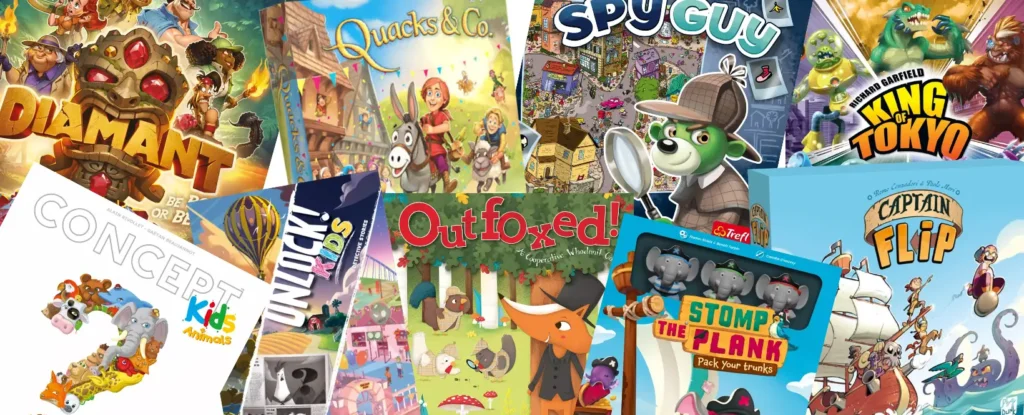
Game Night Doesn’t Need Monopoly Anymore
Let’s be honest. You probably grew up with the same five games everyone did. Monopoly. Uno. Maybe Risk if your family was feeling brave.
You might still own them. You might even still play them out of habit.
But here’s the thing. Familiarity doesn’t mean good. Monopoly can eat two hours of your life and still end in a fight. That’s not game night. That’s a hostage situation with fake money.
So what if game night could look different?
What if a six-year-old could actually make real decisions, without mom or dad running the whole show? What if a 20-minute game gave you more fun than an hour of rolling dice and moving a little metal dog around a board?
That’s what this list is about. Ten modern family games that actually deliver. No cubes-pushing homework simulators here.
What Actually Makes a Game “Family Friendly”
Before we get into the list, here’s what I looked for in each game.
- Can a kid learn it fast?
- Do adults actually enjoy playing, not just tolerate it?
- Does everyone stay in the game until the end?
- Is there real interaction, not just quiet solo turns?
- Would you actually want to play it again tomorrow?
That last one matters more than people think. A game night win.
Alright. Let’s get into it.
Why Modern Family Games Just Hit Different
Simple Rules Don’t Mean Boring Games
Here’s something people get wrong. They think complexity equals depth. It doesn’t.
A game can have three rules and still make you sweat a little. Push Your Luck games prove this every time.
Short Games Fit Real Life
Nobody has three hours on a Tuesday. Games under 30 minutes actually get played. Ones that take forever just sit on the shelf, judging you.
Shorter also means you can play again right away. Win one, lose one, laugh about both.
Kids Don’t Need “Kid Games”
The best family games let kids and adults play the same game. Not a watered-down version. The real thing.
That’s the magic trick these games pull off.
Flip 7
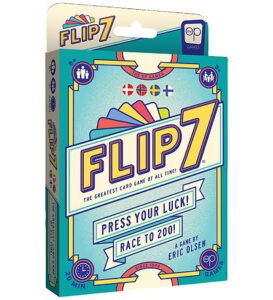
Players: 3–18 | Age: 8+ | Time: ~20 min | Complexity: 1.0/5
Flip 7 is about as simple as it gets. Flip cards, add up numbers, don’t get a duplicate. Stop before you bust, or push your luck for more.
Every single turn asks the same brutal question. Do you stop now, or gamble it all?
Some would call it heavy on luck. But I will call it calculated luck as higher numbers are more likely to be drawn. Because if you draw two identical numbers you go bust and get nothing in that round. Example: the deck is made up of cards with numbers 0 to 12. The number is the points you get if you don’t go bust. So higher numbers equals good? Yes and no. Higher numbers give more points but there are many more of them in the deck, so you statistically have a higher risk of drawing one.
Explanation: in the whole deck there are 12 cards with the number 12 = high risk, high reward. While there are only one “0” and one “1” and two “2’s” and three “3’s” and four “4’s” etc.
Why it works for families:
It plays up to 18 people. Yes, eighteen. Grandma, cousins, the neighbor’s kid, all at once.
Pros:
Fast, easy to teach, huge player count, genuine tension. Very fast and very almost zero downtime (waiting for others) you are investing in everything everyone is doing all the time.
Cons:
Heavy on luck. Could have elements of take-that (messing with others on purpose.
Better than the classics because:
No waiting an hour for something to happen. Every flip is a decision.
Lots of stand up moments.
Best For: Big family gatherings and people who like a little chaos.
👉 Check Price on Amazon
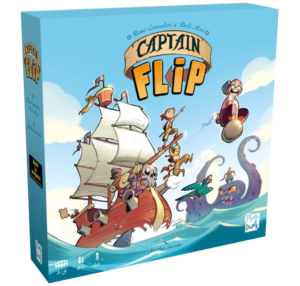
Captain Flip
Players: 2–5 | Age: 8+ | Time: ~20 min | Complexity: 1.2/5
Flip a tile, or keep the one you drew. That’s the whole hook. Simple choice, real consequences.
You’re building a pirate crew, and every crew member has its own ability. It sounds simple. It plays smarter than you’d expect.
Every tile has a power. If you don’t like the tile you drew, you can flip it. But then you have to add it to your pirate crew. That’s the push your luck aspect of the game.
Pros:
Approachable, meaningful choices, replayable thanks to variable powers and maps.
Cons:
Caps at five players. Younger kids might need help adding up scores.
Better than the classics because:
You’re not just moving a piece around. You’re actually deciding your own path, every single turn.
Best For: Families who want light strategy without a rulebook headache.
👉 Check Price on Amazon
Quacks & Co: Quedlinburg Dash

Players: 2–4 | Age: 6+ | Time: ~25 min | Complexity: 1.2/5
This one’s a racing spin-off of the beloved Quacks of Quedlinburg. Build your bag, roll your ingredients, race down the track.
You probably never tried a bag builder game before.
Bag building just means everyone has a bag with items with a picture on it (apple, berries, pumpkins, etc.) you simply just draw one item on your turn. Depending on what you draw your animal moves on the race track.
Or you draw sleepy clouds. Which puts your to sleep – which you don’t want.
Every starts out with the exact same number of items and the exact same kind of item.
But during the game you get to add (buy) new items to add to your bag that are more powerful. by adding stuff to your bag you not only make the items more powerful you also decreases the risk of drawing sleepy clouds.
Kids get the race. Adults get the tactics. Everybody’s happy.
Pros:
Great sense of progression, fun dice rolls, more depth than the box suggests.
Cons:
Randomness can swing a game hard. Bag-building takes one round to click.
Better than the classics because:
It sneaks in engine-building without ever feeling heavy.
Best For: Families who like a race with a bit of brains behind it.
👉 Check Price on Amazon
Diamant
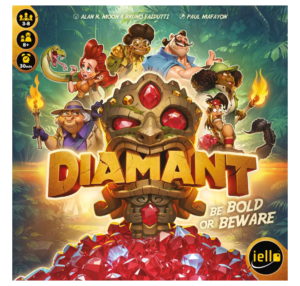
Players: 3–8 | Age: 8+ | Time: 20–30 min | Complexity: 1.1/5
You’re exploring a cave full of treasure. Push deeper for more gems, or turn back and keep what you’ve got.
Here’s the fun part. Everyone decides at the same time. No waiting your turn while you overthink it.
I’ve watched a table of eight people scream at once over this game. That’s a good sign.
This game invites table talk and tries to (lightly) manipulate the other players.
While you try to convince the other players to move forward into the cave while you actually want to go back to camp. Because if the cave shows a trap everyone who chose to move on into the cave goes bust and gets nothing. While you were “smart” by going back to camp and keeping all your gems.
But if you chose to go back and the other players (including those you persuaded to push further into the cave) don’t see a trap. They keep collecting more gems.
So it´s nerve wracking.
I’ve seen some plays where the obvious action was to go back. But one player went deeper into the cave and got a bunch more gems than any of us.
That was a real stand up moment and high fives all around.
Pros:
Easy to teach, supports up to eight players, constant tension.
Cons:
Push-your-luck at its core, so it can feel predictable after a while.
Better than the classics because:
No dice deciding your fate. Just you, your nerve, and everyone else’s poker face.
Best For: Big groups and people who like squirming under pressure.
👉 Check Price on Amazon
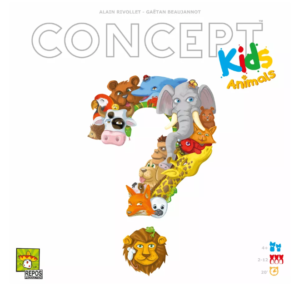
Concept Kids: Animal
Players: 2–12 | Age: 4+ | Time: ~20 min | Complexity: 1.2/5
Cooperative, icon-based, and built for little ones. Players use pictures to describe an animal. No reading required.
This is one of the few games where a four-year-old can genuinely contribute. Not “pretend to help.” Actually, help.
This game is so great and I´ve played extensively with my 4 year old AND 9 year old at the time (and still play it now when they are a couple of years older).
You work together where one gives clues to the others about which animal they are trying to make us guess. It actually teaches the kids about features on animals.
For instance they have a Cat.
The cat can live in a family house, it´s small, it´s medium fast, it has sharp teeth, it has X color (could be the cat in the picture they refer to or their own house cat), it has four legs, etc.
Pros:
Great for young kids, cooperative, big group friendly, minimal reading.
Cons:
Less competitive. Older siblings might crave more of a challenge eventually.
Better than the classics because:
No waiting until a kid can read to let them play. They’re in from turn one.
Best For: Mixed-age families with young kids in the mix.
👉 Check Price on Amazon
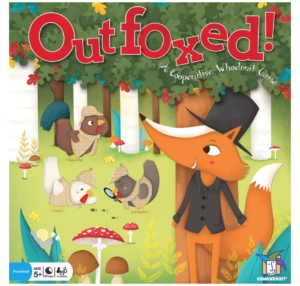
Outfoxed!
Players: 2–4 | Age: 5+ | Time: 15–20 min | Complexity: 1.1/5
A pie went missing from Mr. Peppercorn’s kitchen. Your job? Solve it together, before the thief hops the fence.
You have some suspects (the Fox) in various outfits with three distinct features, ex, a hat, a cane, a briefcase, a scarf, glasses, a cape, etc.
It’s a cooperative deduction with a little decoder tool, and kids genuinely love cracking the case. You feel like a detective. And chicken detective – literally.
The decoder tool is awesome. My youngest (even when she was 4 years old) gets all excited when it’s time to use the decoder.
Does the suspect have a hat on?
Decoder says Yes or No.
Do your suspects have a hat on?
If the decoder says yes. Then your suspect could be the culpirt.
Pros:
Great intro to deduction, cooperative, fast, kids can meaningfully contribute.
Cons:
Only up to four players. Adults might solve it a little too fast.
Better than the classics because:
Nobody’s trying to bankrupt anybody. It’s “can we solve this together” instead of “who wins.”
Best For: Families who’d rather team up than fight it out.
👉 Check Price on Amazon
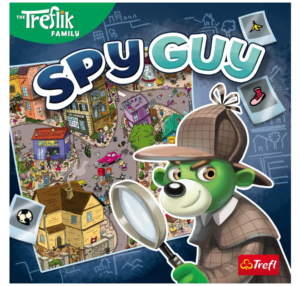
Spy Guy
Players: 1–4 | Age: 5+ | Time: ~20 min | Complexity: Light
A visual search-and-spot game. No heavy reading, no complicated setup. Just sharp eyes and a bit of sneaky fun.
Think “Where´s Waldo”.
Where you are a detective trying to catch up to the bad guy on a type of race track throughout the board before he escapes!
If you (collectively) catch up to him you win!
You have a huge board with a bunch of little items, like, gloves, a football, an icecream, a bird, a newspaper, etc. A lot of stuff. And you try to find multiple of one specific item scattered all over the board.
For instance this round you all need to find all the “White gloves”. You know how many of each item there is.
You have around 45 seconds. So when the clock starts everyone looks all over the board to find them. You dont have to find them all. But the more you find the more you move your character on the race track (trying to catch up to the bad guy).
But he also moves a set amount of steps each round.
super fun, super easy. You can play it with 4 year olds… maybe even younger.
Pros: Accessible for young kids, quick to explain, even works solo.
Cons: Not much strategic depth. Some families will love the searching, others less so.
Better than the classics because: The search itself is the fun. Kids can beat adults fair and square here.
Best For: Younger kids who aren’t quite ready for reading-heavy games.
👉 Check Price on Amazon
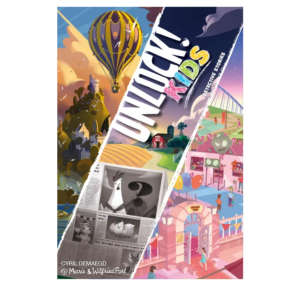
Unlock! Kids
Players: 1–4 | Age: 6+ | Time: ~20 min | Complexity: 1.4/5
A pint-sized escape room, in a box. No app needed. Just cards, clues, and a bit of teamwork.
There’s something special about the moment a puzzle clicks and the whole table shouts at once. Every group needs that.
Attention to details and pattern recognition. It is also some of the best ways to develop the cognitive skills in kids early on. So for that it really is a master class in cooperative, tension, a-ha moments within a short period of time.
Pros: Cooperative, Puzzle-lovers dream, kids can take the lead, no phones or apps needed.
Play time is around 30 minutes.
There are around 6 different scenarios to play with.
From beginner to more advanced, while still within kids of 8 and younger.
Cons: Not competitive. Puzzle enjoyment is a personal thing. Adults may need to nudge a clue here and there.
Better than the classics because: You’re not chasing points. You’re solving something together, like a tiny adventure.
My son and I have played all the scenarios and sometimes we fail or get some wrong turns (a wrong choice card). But you can keep at it until you solve the puzzle. The only thing the “wrong turn cards” do is just lower your score. Which you can totally disregard and just have fun with it.
Best For: Families who love a good puzzle over a scoreboard.
👉 Check Price on Amazon
King of Tokyo

Players: 2–6 | Age: 7+ | Time: ~30 min | Complexity: 1.5/5
Giant monsters. Dice. Chaos. What’s not to love?
It plays like Yahtzee had a baby with a kaiju movie. Roll, reroll, smash, and grab power-ups along the way.
What’s not to like, everyone controls one big monster Kaiju battling the other players Kaiju.
One is stomping around in the city while everyone else is punching and attacking that player.
There are great points to win in the city of Tokyo. But it comes at a cost as all damage is dealt to that player. Until they had enough and leaves Tokyo.
It’s like Yahtzee. Roll 5 dice, choose a combination of the symbols on the dice. Hand (damage), lightning bulbs (cubes that let you buy awesome powerups), or just straight up victory points. Do this three times and get what you´ve rolled.
Pros: Great theme, easy rules, strong interaction, enough depth to keep adults hooked.
Can be played with kids down to the age of 7 and above.
Cons: Players can get knocked out early. Combat’s a bit confrontational for very sensitive kids. But games are very short. So if you are really unlucky and get knocked out early. You´ll only have to wait 10 minutes for the game to end
Better than the classics because: Every dice roll is a real decision, not just a number you shrug at.
Best For: Competitive families who like a bit of noise and destruction.
👉 Check Price on Amazon
Stomp the Plank
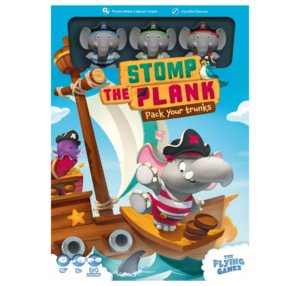
Players: 2-4 | Age: 4+ | Time: 15–20 min | Complexity: Light
You all have a small and cute elephant that you try to be the last one standing on its own plank.
On your turn you draw as many cards as you want from the captain’s chest. That card could show one of 7 different images (sword, treasure map, coin purse, rubby, compass or a monocular). You keep drawing one card until you either see two of the same image on two different cards or you just choose to stop.
If you see two images of the same, you go bust and must advance your elephant on step further out onto your plank.
But if you stop. You’ll add 1 to 4 discs to every other player at the end of their plank.
Which adds weight to their plank. If anyone has too many discs and/or moved too far out onto their plank. They’ll eventually fall down and be out of the game.
Are you the last to stay on your plank and not fall down. You win.
You push your luck to see if you could get all different images on flipped cards. If you get all 7 different images flipped. you Win.
This game can be won in the first round, in the first turn. No biggy just play again. Then it’s chaos, as pirates get shoved and pushed toward the edge of the plank.
Pros: Very easy to learn, highly interactive, plenty of laughs.
Cons: Elimination can sting for younger kids.
Better than the classics because: No just waiting for your turn. Everyone´s turn matters and could have an impact on your progress.
Best For: Families who don’t mind a little friendly betrayal.
👉 Check Price on Amazon
How to Pick the Right Game for Your Family
Got Very Young Kids?
Go simple, go visual, go cooperative.
Try: Concept Kids: Animal, Outfoxed!, Spy Guy
Want Something Adults Will Actually Enjoy?
Look for real decisions and real interaction.
Try: Captain Flip, Flip 7, King of Tokyo, Diamant
Puzzle-Loving Family?
Try: Unlock! Kids. It’s basically an escape room without leaving the couch.
Big Family or Group?
Player count matters more than people think. Check it before you buy.
Try: Flip 7 (up to 18!), Diamant (up to 8), Concept Kids: Animal (up to 12)
Short on Time?
Fifteen to twenty minutes is the sweet spot. You can play twice and still make bedtime.
Try: Flip 7, Captain Flip, Diamant, Outfoxed!, Spy Guy, Unlock! Kids, Walk the Plank
Competitive Crowd?
Try: Flip 7, Captain Flip, Diamant, King of Tokyo, Walk the Plank
Cooperative Crowd?
Try: Concept Kids: Animal, Outfoxed!, Unlock! Kids, Spy Guy
Family Games vs. The Classics: An Honest Comparison
The classics aren’t evil. Monopoly has nostalgia going for it. So does Risk. There’s comfort in the familiar.
But nostalgia doesn’t fix bad design. Here’s the honest tradeoff.
| Classic Game Problem | What Modern Games Fix |
| Games drag on forever | 15–30 minute sessions |
| Lots of sitting around waiting | Constant decisions |
| Roll dice, move piece, repeat | Push-your-luck, deduction, puzzles |
| Reading-heavy rules | Visual, icon-based systems |
| Kids can’t keep up with adults | Mechanics built for mixed ages |
| Early elimination, sit and sulk | Cooperative and score-based formats |
That’s the real difference. It’s not that the classics are trash. It’s that we’ve had 60 years to design better ones.
How I Picked These Ten
I kept complexity low on purpose. Most of these sit around 1.0 to 1.5 on the BGG weight scale (it’s a website for dedicated board gamers htat have played and tested thousands of games, many times and give their verdict). Nothing here requires a PhD to explain.
Ages range from four all the way up to adults. Nobody gets left out.
Most games clock in under 30 minutes. That’s realistic for a Tuesday night, not just a lazy Sunday.
And I made sure the mechanics were different across the board. Push-your-luck, deduction, racing, bluffing, puzzles. Nobody wants ten versions of the same game dressed up differently.
Buyer’s Guide: Which One Should You Actually Buy?
Best Overall for a Mixed Family: Captain Flip. Simple rules, real strategy, works for everyone.
Best for Big Groups: Flip 7. Eighteen players. Let that sink in.
Best for Young Kids: Concept Kids: Animal. Four years old and up, no reading needed.
Best Cooperative Mystery: Outfoxed! Solve it together instead of fighting each other.
Best Puzzle Game: Unlock! Kids. Escape room energy, zero app required.
Best for Competitive Families: King of Tokyo. Dice, monsters, a bit of chaos.
Best Push-Your-Luck Game: Diamant. Clean, tense, and always fun.
Best for Quick Nights: Flip 7, again. Twenty minutes, very low effort to teach.
Best for Deduction: Spy Guy. Sharp eyes beat reading skills here.
Best for Bluffing and Chaos: Walk the Plank. Guess wrong, laugh hard.
👉 Check Price on Amazon for any of these picks.
Final Verdict: The Best Games Aren’t Always the Ones You Grew Up With
So here we are, back to the original question. Does game night need to mean Monopoly, again?
Probably not.
The best family games don’t remove luck or dumb everything down. They just use simple rules to create something better. Real choices. Real laughs. Real teamwork.
A family with a four-year-old needs something different than a family with teenagers. A group of three needs something different than a group of twelve.
So, what kind of game night are you after? Cooperative, competitive, strategic, chaotic, or puzzle-focused?
Scroll back up to the table. Pick one. Go play it tonight.
Quick Comparison: 10 Family Friendly Board Games
Here’s the fast version, for those short on time (or patience).
| Game | Players | Age | Time | Complexity | Best For |
| Flip 7 | 3–18 | 8+ | ~20 min | 1.0/5 | Big groups & push-your-luck |
| Captain Flip | 2–5 | 8+ | ~20 min | 1.2/5 | Light strategy |
| Quacks & Co: Quedlinburg Dash | 2–4 | 6+ | ~25 min | 1.2/5 | Racing & bag-building |
| Diamant | 3–8 | 8+ | 20–30 min | 1.1/5 | Risk-taking |
| Concept Kids: Animal | 2–12 | 4+ | ~20 min | 1.2/5 | Younger kids |
| Outfoxed! | 2–4 | 5+ | 15–20 min | 1.1/5 | Cooperative deduction |
| Spy Guy | 1–4 | 5+ | ~20 min | Light | Visual deduction |
| Unlock! Kids | 1–4 | 6+ | ~20 min | 1.4/5 | Puzzles |
| King of Tokyo | 2–6 | 8+ | ~30 min | 1.5/5 | Dice & chaos |
| Walk the Plank | 3–5 | 6–8+ | 15–20 min | Light | Bluffing |
Bookmark this table. You’ll probably scroll back to it.
Frequently Asked Questions
What Makes a Board Game Family Friendly?
It’s the mix. Easy to learn, quick to play, and interesting enough that adults don’t zone out halfway through.
What Are the Best Family Board Games for All Ages?
Depends on your family. Young kids do best with Concept Kids: Animal or Outfoxed!. Adults who want strategy should try Captain Flip or Diamant.
What Board Games Can Kids and Adults Play Together?
Concept Kids: Animal, Outfoxed!, Captain Flip, Flip 7, and King of Tokyo all work well, depending on age.
What Is a Good Board Game for Game Night?
Anything under 30 minutes. Short games mean you can actually play more than once before everyone’s ready for bed.
Are Modern Board Games Better Than Classic Board Games?
Not always “better.” Just more varied. Shorter playtimes, more meaningful choices, less waiting around for your turn.
What’s the Best Board Game for a Family With Young Kids?
Concept Kids: Animal, Outfoxed!, and Spy Guy are great starting points. Unlock! Kids fits well once kids hit around six.
Editorial Disclosure: Cubesalad is reader-supported. When you buy through links on our site, we may earn an affiliate commission at no extra cost to you. Read more.