Introduction & Overview
Some games want you to fight. Harmonies wants you to relax. You build a pretty landscape, fill it with animals and enjoy the view. Nobody gets robbed. Nobody gets attacked. Your sister will have to find another game for that.
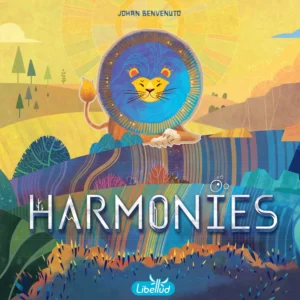
This Harmonies board game review looks at how it plays, why people love it and where it falls short. It is one of the cosiest nature games out there, and it looks great on the table.
What Is Harmonies?
In Harmonies, you lay coloured nature tiles to build landscapes. Those landscapes become homes for animals. The more animals you house, the more points you score.
The theme is nature, scenery and animal habitats. Your landscape builds up as you play, and it feels three-dimensional. It looks a bit like a tiny world growing in front of you.
How Harmonies Works: Mechanics & Gameplay
Drafting and Tile Placement
Each turn is short and simple. You take three tiles. Then you place them on your own landscape board. That is the core of the game.
Everyone builds their own landscape. So you spend your time on your own little puzzle. It is calm and quiet, and it suits a cosy tile placement board game night.
The choice is where each tile goes. Put it here, and a pattern gets closer. Put it there, and you keep your options open. Small choices, big smiles.
Turns move fast. You take your tiles, place them and pass the turn. So there is not much waiting around. That keeps the game short and light.
Animal Cards and Habitat Pattern Building
Animals live in habitats. Each animal needs a certain pattern of tiles. If your landscape matches the pattern, you can place the animal there.
That is the pattern building part. You look at your board and think: what can I make with this? Then you plan the next few tiles to match.
Scoring and Balancing Immediate vs. Long-Term Goals
Animals give you points. You also score by finishing habitat patterns and by hitting the goals on the nature cards. At the end, the player with the most points wins.
Here is the catch. Animals can limit where you place things later. A quick animal now may block a better one later. So you must weigh fast points against a long-term plan.
A tip for new players: keep some space free. Do not fill every spot at once. Your future self will thank you.
What Makes Harmonies Stand Out?
Gorgeous Presentation & a Tactile 3D Feel
This game is a looker. The scenery you build has a real 3D feel. It is a lovely 3D pattern building board game, and people will want to look at your board.
It feels good to build, too. You get the same joy as stacking blocks as a kid. Only now you have a grown-up score sheet.
Fast Learning Curve with Satisfying Tactical Depth
You can learn Harmonies in a few minutes. Take three tiles. Place them. Maybe place an animal. That is the whole turn.
The complexity is about 2.0 out of 5, so it is light to medium. But the puzzle is still fun. You will think about your board, and you will want to try again.
Players give it a score of around 8.0 out of 10. That is a high number for a game this easy to learn.
Smooth, Rewarding Solo Mode
Harmonies plays from 1 to 4 players. The solo mode is a strong part of the game. It is a good way to enjoy a quiet puzzle on your own. Many fans of relaxing 1–4 player board games will like it.
It also works well as a teaching game. You can explain it in a minute, then let people play. Good for new players, and good for the grown-ups who teach them.
Potential Limitations to Consider
Low Direct Player Interaction
Players mostly build in their own space. Some call this parallel solitaire. You do your puzzle, and I do mine. We just sit at the same table.
If you want to mess with other players, this is not the game. There is very little of that here.
Tile Draw Luck and Tight Space
Luck plays a part. You do not always get the tiles you want. A few bad pulls can slow your plan down.
The board is also small. Space gets tight fast. That is part of the puzzle, but it can frustrate some players.
How Does Harmonies Compare to Genre Giants?
Harmonies vs. Cascadia
Cascadia also has tile laying, patterns and a nature theme. It is a bit more draft-based. That means players choose from shared options.
Harmonies is more about the landscape you shape on your own. If you liked Cascadia, you will feel at home here.
Read our full review of Cascadia here.
Harmonies vs. Azul
Azul is a cleaner tile-drafting and pattern game. It is more abstract. Harmonies has a nature theme and a more organic feel.
Read our full review of Azul here.
Harmonies vs. Calico & Bärenpark
Calico is a lighter puzzle with an animal theme. Bärenpark is about placing shapes and building patterns. Both are fun puzzles.
Harmonies sits somewhere in between. It has animals like Calico. It also has the pattern joy of Bärenpark.
Who Is Harmonies For?
Ideal for Families, Casual Gamers, and Cozy Puzzle Fans
Harmonies is great for families and casual players. It also suits fans of Azul and Cascadia. It is a good fit if you want a pretty game without conflict.
Looking for the best nature board games? This one belongs on your shortlist.
Who Might Want Something Else?
Skip it if you want hard competition. Skip it if you play with large groups, since it only goes to four. And skip it if you want deep, long strategy.
Final Verdict & Rating
Harmonies is pretty, quick and easy to learn. It gives you a calm puzzle with a bit of planning. The solo mode is a bonus.
It has limits. There is little interaction, and luck matters a bit. But for a relaxed night, it is hard to beat.
Who Should Play It?
Play it if you love cosy games and nice scenery. Play it with family or on your own. Skip it if you want fierce battles or heavy strategy.
Frequently Asked Questions (FAQ)
Is Harmonies difficult to learn?
No. It has a complexity of about 2.0 out of 5 and an age rating of 10+. Taking three tiles and placing them is simple. Making the right patterns takes a bit of planning.
How long does a game of Harmonies take, and how many people can play?
Harmonies plays 1 to 4 players. A game takes about 30 to 45 minutes. That makes it a good pick for a weeknight or a family night.
Does Harmonies have good solo play?
Yes. The solo mode is one of the strengths of the game. You get a relaxing puzzle with no other players needed.
Is Harmonies a game with a lot of player interaction?
No. Players mostly build on their own boards. It is a calm puzzle, not a fight.
Buy at AmazonKey Details & Specifications
| Detail | Info |
|---|---|
| Publisher | Libellud |
| Year | 2024 |
| Players | 1–4 |
| Playing time | 30–45 minutes |
| Age | 10+ |
| Complexity | About 2.0 out of 5 |
| Player score | Around 8.0 out of 10 |
Editorial Disclosure: Cubesalad is reader-supported. When you buy through links on our site, we may earn an affiliate commission at no extra cost to you. Read more.